Continue Listening in the App
Experience the full story of Gog and Magog with professional narration and immersive ambient sounds.
About This Story
Quran Reference
Surah Al-Kahf (18:94-99), Surah Al-Anbiya (21:96)
Key Themes
Audio Duration
10 min of professional narration
Available In
English, Arabic, German, Dutch, French, Turkish
Key Lessons from This Story
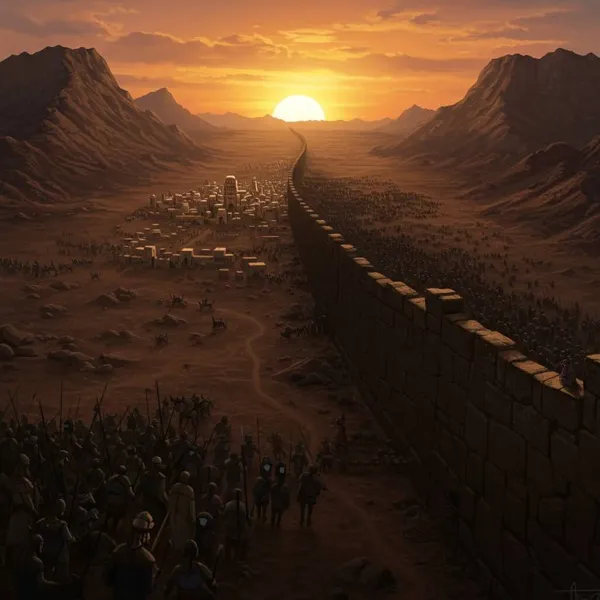
- Allah's promise is always fulfilled — Dhul-Qarnayn himself declared that the barrier would one day be leveled when Allah's promise comes. Despite its immense strength, the wall is temporary — held in place only by Allah's decree. This teaches believers that all worldly structures and powers are subject to Allah's timeline, and that the events of the Last Day are as certain as the rising of the sun.
- True leadership serves without expecting reward — When the people offered Dhul-Qarnayn tribute to build the barrier, he refused payment, saying that what Allah had given him was sufficient. He used his God-given power and resources to protect the vulnerable without seeking personal gain. This is the model of righteous leadership in Islam — power exercised as a trust from Allah, not a means of enrichment.
- Corruption can be contained by divine decree — Gog and Magog represent the reality that destructive forces exist in the world, but Allah has the power to restrain them until their appointed time. The barrier is a physical manifestation of this principle — evil is real, but it operates only within the boundaries Allah has set.
- The unseen (ghayb) must be believed in — The exact location of Gog and Magog and their barrier remains unknown to humanity. Believing in their existence despite not being able to see or locate them is part of believing in the unseen — a fundamental requirement of faith mentioned at the very beginning of the Quran (2:3).
- Reliance on Allah is the ultimate refuge — When Gog and Magog are finally released and overwhelm the earth, it is not human armies or technology that will stop them. It is the dua (supplication) of Prophet Isa and the believers, answered by Allah through a simple worm, that will destroy them all in a single night. This teaches that no matter how great the threat, the believer's greatest weapon is their connection to Allah.
Historical and Theological Context
Gog and Magog (Ya'juj and Ma'juj) are mentioned in two surahs of the Quran. In Surah Al-Kahf (18:94-99), their story is told within the narrative of Dhul-Qarnayn's journeys, focusing on the construction of the barrier. In Surah Al-Anbiya (21:96-97), their release is connected directly to the approach of the Day of Judgment: "Until when Gog and Magog are let loose and they, from every elevation, descend." This dual mention — once in a historical context and once in an eschatological context — establishes Gog and Magog as a bridge between past and future in Islamic theology.
Islamic scholars unanimously affirm that Gog and Magog are human beings — descendants of Adam, peace be upon him, and specifically from the lineage of Yafith (Japheth), son of Nuh (Noah). They are not mythological creatures or supernatural beings, despite the legendary characteristics attributed to them in some non-Islamic traditions. The hadith in Sahih al-Bukhari states that on the Day of Judgment, Allah will say: "O Adam, bring forth the share of the Hellfire," and out of every thousand, 999 will be from Gog and Magog — indicating their staggering numbers relative to the rest of humanity.
The story of Gog and Magog holds a central place in Islamic eschatology (the study of end-times events). Their release is considered one of the ten major signs of the Hour, alongside the descent of Prophet Isa, the appearance of the Dajjal (Antichrist), the rising of the sun from the west, and others. The sequence described in hadith literature places their emergence after the descent of Isa and his defeat of the Dajjal, making it one of the final tribulations before the Day of Resurrection itself. The Prophet Muhammad (PBUH) spoke about them with great concern, reportedly saying: "Woe to the Arabs from an evil that is approaching" — referring to the opening of a breach in the barrier of Gog and Magog (Sahih al-Bukhari).