Continue Listening in the App
Experience the full story of The Migration (Hijrah) with professional narration and immersive ambient sounds.
About This Story
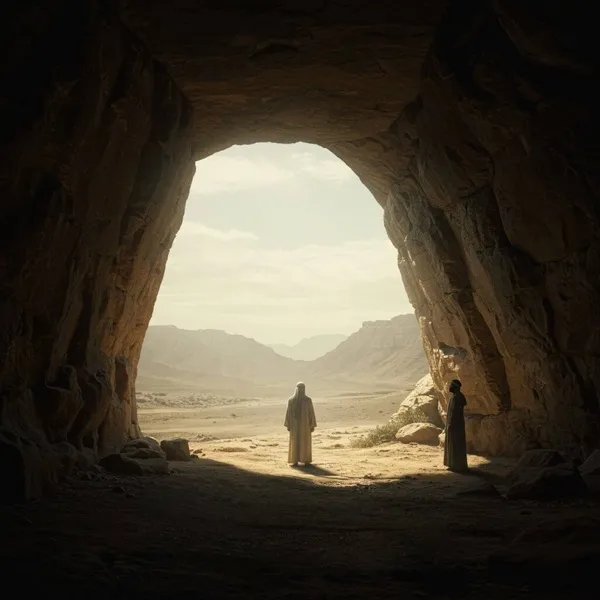
Quran Reference
Surah At-Tawbah (9:40), Surah Al-Anfal (8:30)
Key Themes
Audio Duration
18 min of professional narration
Available In
English, Arabic, German, Dutch, French, Turkish
Key Lessons from This Story
- Trust in Allah (Tawakkul) while taking practical measures — The Prophet did not simply pray and wait for a miracle. He planned meticulously — arranging a guide, choosing an unconventional route, staging a decoy, and organizing intelligence and supply networks. Yet he also placed his ultimate trust in Allah's protection. In the Cave of Thawr, his calm words "Do not grieve, for Allah is with us" perfectly embodied the balance between human effort and divine reliance that Islam teaches.
- Sacrifice for faith is the highest form of devotion — The Muhajirun left behind homes, businesses, families, and lifetimes of accumulated wealth to follow the command of Allah. Suhayb ar-Rumi surrendered his entire fortune just to be allowed to leave. This teaches that attachment to worldly possessions must never outweigh commitment to faith, and that those who sacrifice for Allah's sake will find themselves enriched in ways this world cannot measure.
- True brotherhood transcends blood and tribe — In Medina, the Prophet paired each Muhajir (migrant) with an Ansari (local), creating bonds of brotherhood so deep that the Ansar offered to share their homes, wealth, and even their orchards equally. This revolutionary social system demolished the tribal hierarchies of Arabia and established that the bond of faith is stronger than the bond of blood.
- Youth and courage in the service of Islam — Ali ibn Abi Talib, barely twenty years old, volunteered to sleep in the Prophet's bed knowing assassins surrounded the house. Asma bint Abu Bakr tore her belt to carry provisions to the cave. Abdullah ibn Abu Bakr, still a young man, served as an intelligence agent. These young people remind us that age is no barrier to serving a great cause with courage and conviction.
- Allah's plan prevails over human conspiracies — The Quraysh assembled their greatest minds to plot the Prophet's assassination, yet their plan was defeated by divine intervention. The spider's web, the dove's nest, and the sinking hooves of Suraqah's horse were all signs that no human plot can overcome Allah's decree. "They plan, and Allah plans. And Allah is the best of planners" (Quran 8:30).
Historical and Theological Context
The Hijrah of 622 CE is one of the most consequential events in world history. It marks not only the beginning of the Islamic (Hijri) calendar — established by Caliph Umar ibn al-Khattab — but the transformation of Islam from a persecuted faith community into a state with governance, law, and military capability. The Quran itself references the Hijrah in multiple passages, most notably in Surah At-Tawbah (9:40), which describes the cave episode, and Surah Al-Anfal (8:30), which exposes the Quraysh's assassination plot.
The historical context of the Hijrah is inseparable from the two Pledges of Aqabah. In the first pledge (621 CE), twelve men from Medina accepted Islam and vowed to uphold basic moral principles. In the second pledge (622 CE), seventy-five Medinan Muslims — including two women — secretly met the Prophet and pledged to protect him as they would protect their own families, even at the cost of war with all of Arabia. This pledge effectively made the migration possible and established Medina as a sanctuary for the believers.
Upon arriving in Medina, the Prophet drafted the Sahifat al-Madinah (Constitution of Medina), one of the earliest written constitutions in human history. This remarkable document defined the rights and obligations of all citizens — Muslims, Jews, and pagan Arabs alike — established religious freedom, mutual defense obligations, and a system of justice. The Prophet also instituted the mu'akhah (brotherhood) system, pairing each Meccan migrant with a Medinan host, creating an entirely new form of social solidarity that transcended tribal allegiance. These institutions transformed Medina into the model Islamic society and laid the groundwork for the rapid expansion of Islamic civilization across three continents within a century of the Prophet's death.