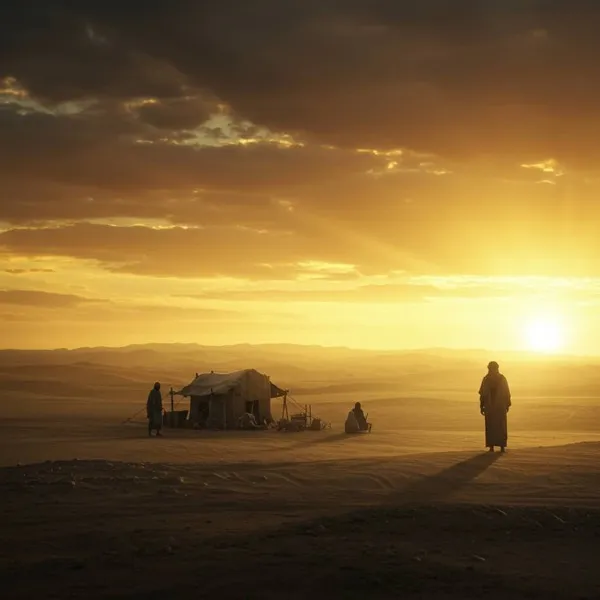
In the annals of prophetic history, the narrative of Prophet Nuh — Noah — peace be upon him, stands as a testament to unwavering faith and perseverance.
Centuries after the time of Prophet Idris, humanity had strayed from the monotheistic path... succumbing to idol worship and moral decay.
In His boundless mercy, Allah chose Nuh, peace be upon him, to guide his people back to righteousness.
Endowed with eloquence and patience, Nuh embarked on his divine mission. He addressed his people, highlighting the wonders of the universe — the alternation of night and day, the celestial bodies, the flora and fauna — all signs pointing to the existence of one true God.
He warned them solemnly: "Do not worship these idols! Such practices are deceptions of Shaytan, and there will be severe punishment if you persist."
Despite his earnest efforts... the response was disheartening.
The affluent and powerful dismissed his message, scoffing arrogantly: "We see you as nothing but a man like ourselves!"
Nuh acknowledged his human nature, but clarified: "Allah intentionally chose a human messenger to guide humans. If angels inhabited the earth, Allah would have sent an angel."
The leaders of his community, blinded by arrogance, demanded that Nuh dismiss his humble followers if he sought their belief. They argued: "No faith could encompass both the elite and the impoverished!"
Nuh responded with wisdom: "Material wealth holds no value in the sight of Allah. It is the purity of one's heart that matters."
Undeterred by their mockery and rejection... Nuh continued his mission for an astounding nine hundred and fifty years!
Each generation that arose was cautioned against his teachings, leading them further astray.
Frustrated and sorrowful over their obstinance, Nuh turned to Allah in supplication, lamenting: "My Lord! My efforts only seem to increase their disbelief!"
Then came the divine decree. Allah revealed to Nuh a truth both solemn and final: "None of your people will believe except those who have already believed, so do not be distressed by what they have been doing" (Quran 11:36). The door of mercy, held open for nearly a millennium, was closing. Those who would believe had already believed. Those who persisted in their rejection had sealed their own fate.
With this revelation came a command unlike any given before: Allah instructed Nuh to build an enormous Ark. Not beside a river. Not near the sea. On dry land, far from any body of water. The task was immense — timber upon timber, plank upon plank — and Nuh set to work with his own hands, guided by divine inspiration. "And construct the ship under Our observation and Our inspiration" (Quran 11:37).
His people watched in disbelief and amusement. The elders who had opposed him for centuries now had fresh material for their mockery. Every time a group of leaders passed by Nuh as he hammered and labored, they ridiculed him openly: "O Nuh! You were a preacher — now you have become a carpenter? Why is this so-called prophet building a ship in the middle of the desert, where there is not a drop of water in sight?" They laughed until tears streamed from their eyes, convinced that Nuh had finally lost his mind.
But Nuh, peace be upon him, responded with the quiet dignity of one whose trust rests entirely in his Lord. He replied: "If you ridicule us, then we will ridicule you just as you ridicule" (Quran 11:38). He warned them that the punishment they found so laughable would come to them in a way they could not escape — and that they would know, soon enough, who the true fools were.
Day after day, Nuh continued building. He did not waver. He did not question the wisdom of constructing a vessel where no water existed. This was the essence of his faith — obedience over logic, trust over doubt. If Allah commanded it, there was no need for the reason to be visible to human eyes. The ship grew larger, towering over the barren landscape, a monument of faith standing in defiance of a people who had abandoned their Creator.
Then came the sign. Allah told Nuh: "When Our command comes and the oven overflows with water..." (Quran 11:40). The tannur — an earthen oven, a symbol of the most ordinary, domestic life — would become the harbinger of the most extraordinary catastrophe. When water began gushing from the oven, it meant the flood had begun.
And so it happened. Water surged from the earth beneath, from the very ground they stood upon. The skies, which had been still and silent, split open with torrential rain the likes of which no eye had ever witnessed. "So We opened the gates of the heaven with rain pouring down, and caused the earth to burst with springs, and the waters met for a matter already predestined" (Quran 54:11-12).
Nuh moved swiftly. He loaded onto the Ark a pair of every species — male and female — as Allah had commanded: "Load upon the ship of each [creature] two mates" (Quran 11:40). He brought aboard his family and the small group of believers who had stood by him through centuries of persecution. The Ark was filled not with the wealthy and the powerful, but with the humble, the faithful, and the obedient.
As the waters rose, Nuh's gaze fell upon a figure standing apart from the Ark — his own son. His heart must have shattered in that moment. Across the surging waves, Nuh called out with the desperate love of a father: "O my son! Come aboard with us and be not with the disbelievers!" (Quran 11:42).
But his son, stubborn and proud, refused. He called back: "I will take refuge on a mountain to protect me from the water" (Quran 11:43). He believed the mountains — the tallest, strongest things he knew — could save him. He placed his trust in creation rather than the Creator.
Nuh cried out: "There is no protector today from the decree of Allah, except for whom He gives mercy!" But even as the words left his lips, a wave — towering like a mountain — rose between father and son. And his son was among the drowned.
The Ark sailed through waves described in the Quran as being like mountains (Quran 11:42). The entire earth, or at least the land of Nuh's people, was consumed. Every mocker, every idol, every palace built on arrogance — all of it vanished beneath the relentless water. The civilization that had rejected Allah for nearly a thousand years was erased in a matter of hours.
Even after the floodwaters consumed his son, Nuh's anguish did not subside. He turned to his Lord and pleaded: "My Lord, indeed my son is of my family, and indeed Your promise is true, and You are the most just of judges" (Quran 11:45). It was the cry of a father who loved his child but also trusted his Lord.
Allah's response was firm yet filled with a profound lesson: "O Nuh, indeed he is not of your family; indeed, he is [one whose] work was other than righteous, so ask Me not for that about which you have no knowledge. Indeed, I advise you, lest you be among the ignorant" (Quran 11:46). True family, in the sight of Allah, is defined not by blood alone but by faith and righteous conduct. Nuh immediately sought forgiveness: "My Lord, I seek refuge in You from asking that of which I have no knowledge" (Quran 11:47).
When the divine purpose had been fulfilled, the command came: "O earth, swallow your water, and O sky, withhold [your rain]" (Quran 11:44). And the earth obeyed. The rain ceased. The waters receded, drawn back into the ground as though they had never been. The sky cleared. And the Ark, that monument of faith built by the hands of a prophet on dry land, came to rest gently upon Mount Judi.
Nuh and the believers descended from the Ark into a world cleansed and renewed. It was said to him: "O Nuh, disembark in safety from Us and blessings upon you and upon nations [descending] from those with you" (Quran 11:48). They stepped onto the earth as the seeds of a new humanity. Every person alive today, according to Islamic tradition, traces their lineage back to those who descended from that Ark. Nuh is thus known as the "second father of humanity" — the prophet through whom Allah gave mankind a second beginning.
The story of Prophet Nuh is not merely a tale of destruction. It is, at its heart, a story of renewal — of a world given another chance, of mercy that follows justice, and of a single man's unshakable faith that outlasted centuries of rejection. To learn more about the prophets who came after Nuh and continued this chain of guidance, explore our complete guide to the 25 Prophets in Islam, or continue with the story of Prophet Hud (AS), who was sent to the people of 'Ad after the flood. You can also browse all Quran Stories in our collection.