In the year known as the Year of the Elephant — when Abraha's army marched toward the Ka'bah with a great elephant and was destroyed by flocks of birds sent by Allah — a child was born in the city of Makkah who would change the course of human history forever. His name was Muhammad, son of Abdullah, son of Abdul-Muttalib, of the noble Banu Hashim clan of the Quraysh tribe.
His father, Abdullah, had died before his birth. His mother, Aminah, held the infant in her arms and saw light — according to narrations, a light that illuminated the palaces of Syria. His grandfather, Abdul-Muttalib, named him Muhammad — "the praised one" — a name that had never been given to anyone in Arabia before. It was as if the very heavens had announced, through the choice of this name, the extraordinary destiny that awaited this child.
Following the custom of the Quraysh, the infant Muhammad was sent to the desert to be nursed by a Bedouin woman. Halimah al-Sadiyya of the Banu Sa'd tribe took him into her care, and from the moment she did, blessings surrounded her family — her barren land became fertile, her thin animals grew strong, and her household prospered. It was during this time, when Muhammad was approximately four years old, that the miraculous Opening of the Chest occurred — when angels opened his chest, removed the portion of Shaytan, washed his heart with Zamzam water, and filled it with wisdom and faith.
Muhammad's early life was marked by profound loss. His mother Aminah died when he was six years old, leaving him an orphan. His grandfather Abdul-Muttalib, who had taken him in with great love, passed away just two years later. From that point, his uncle Abu Talib raised him — providing protection and affection, though never great wealth. The Quran itself references these early hardships: "Did He not find you an orphan and give you refuge?" (Quran 93:6). Every trial of his childhood was preparing him for the mission that would require the deepest reserves of patience, empathy, and resilience.
As Muhammad grew into a young man, he became known throughout Makkah by a remarkable title: Al-Amin — the Trustworthy. In a society where tribal rivalries, dishonesty, and exploitation were common, Muhammad stood apart. He never worshipped idols, never drank alcohol, never engaged in the immoral practices of the jahiliyyah (pre-Islamic era of ignorance). People entrusted him with their valuables for safekeeping, and merchants sought him as a partner because of his unimpeachable honesty.
It was this reputation that caught the attention of Khadijah bint Khuwaylid — a wealthy, intelligent, and noble woman of Quraysh. She hired Muhammad to lead a trading caravan to Syria, and when he returned with exceptional profits and glowing reports of his character from her servant Maysarah, Khadijah was deeply impressed. She proposed marriage to him through an intermediary. Muhammad accepted, and they were married when he was twenty-five and she was forty. Their marriage would become one of the most celebrated unions in Islamic history — a partnership of love, faith, and mutual support that endured through the most difficult years of the prophetic mission.
As Muhammad approached his fortieth year, he increasingly withdrew from the noise and corruption of Makkan society to contemplate in solitude. His chosen place of retreat was the Cave of Hira, perched on a mountain overlooking Makkah, where he would spend days and nights in reflection, seeking the truth that his pure heart knew existed beyond the idolatry of his people.
Then came the night that changed everything. In the month of Ramadan, in the year 610 CE, while Muhammad sat alone in the Cave of Hira, the Angel Jibreel (Gabriel) appeared before him in his true angelic form. Jibreel seized Muhammad and pressed him tightly, commanding: "Read!" Muhammad, who could not read or write, replied in distress: "I cannot read." Jibreel pressed him again, harder, and repeated: "Read!" Again Muhammad said he could not. A third time Jibreel pressed him, and then released him with the first words of divine revelation: "Read in the name of your Lord who created. Created man from a clinging substance. Read, and your Lord is the Most Generous. Who taught by the pen. Taught man that which he knew not" (Quran 96:1-5).
Muhammad descended from the mountain, trembling with awe and uncertainty, and rushed to Khadijah. "Cover me! Cover me!" he cried, and she wrapped him in a cloak. When he told her what had happened, Khadijah — without a moment's hesitation — believed him. "By Allah, Allah will never humiliate you," she assured him. "You maintain the ties of kinship, you bear the burden of the weak, you help the destitute, you entertain guests, and you aid those afflicted by calamity." Khadijah became the first person in history to accept Islam — the first Muslim.
The early years of the prophetic mission were marked by secret preaching. The first converts included Khadijah, the young Ali ibn Abi Talib (the Prophet's cousin), Zayd ibn Harithah (the Prophet's freed servant), and Abu Bakr al-Siddiq — the Prophet's closest friend, who would later become the first caliph. Abu Bakr's acceptance was significant because he was a respected merchant whose influence brought many others to Islam, including Uthman ibn Affan, Zubayr ibn al-Awwam, and Abdur-Rahman ibn Awf.
When the message went public after three years, the reaction of Quraysh was fierce. The tribal leaders who had called Muhammad "Al-Amin" now called him a madman, a sorcerer, and a poet. They offered him wealth, power, and kingship if he would abandon his message. His uncle Abu Talib conveyed their offers, and Muhammad's response became immortal: "O uncle, by Allah, if they put the sun in my right hand and the moon in my left to make me give up this matter, I would not give it up until Allah makes it prevail or I perish in the effort." He wept as he spoke, and Abu Talib — though he never accepted Islam — vowed to protect him until death.
The persecution of the early Muslims was severe. Bilal ibn Rabah, an Abyssinian slave who had accepted Islam, was tortured by his master Umayyah ibn Khalaf — dragged through the streets, placed under crushing boulders in the desert sun — yet he would only repeat: "Ahad, Ahad" (One, One), affirming the Oneness of Allah. Sumayyah bint Khayyat became the first martyr in Islam, killed by Abu Jahl's spear for refusing to renounce her faith. The Prophet himself was pelted with stones when he traveled to the city of Ta'if seeking support, until his shoes filled with blood.
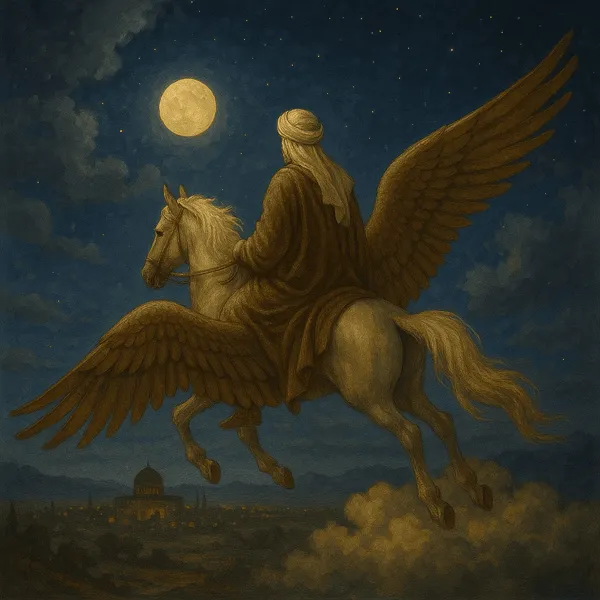
During this period of intense suffering, Allah granted Muhammad one of the most extraordinary experiences ever bestowed upon a human being: the Isra and Mi'raj — the Night Journey from Makkah to Jerusalem and the ascension through the seven heavens. In a single night, the Prophet traveled to Al-Aqsa Mosque, led all the previous prophets in prayer, and ascended through the heavens — meeting Adam, Isa, Yahya, Yusuf, Idris, Musa, and Ibrahim along the way. Beyond the seventh heaven, at the Sidrat al-Muntaha (the Lote Tree of the Utmost Boundary), he received from Allah the commandment of the five daily prayers — the spiritual pillars that would sustain the Muslim ummah for all time.
As the persecution in Makkah became unbearable, Allah opened a new chapter. The people of Yathrib (later renamed Madinah) — the tribes of Aws and Khazraj — accepted Islam and invited the Prophet to their city. In 622 CE, the Hijrah (migration) took place. The Prophet and Abu Bakr left Makkah under cover of night, with the Quraysh offering a bounty of one hundred camels for their capture. They hid in the Cave of Thawr for three days, where a spider spun its web and a dove nested at the entrance — signs of Allah's protection. When Abu Bakr expressed fear, the Prophet reassured him: "Do not grieve; indeed Allah is with us" (Quran 9:40). They arrived safely in Madinah, where the Prophet was welcomed with the famous chant: "Tala'al-Badru Alayna" (The full moon has risen upon us).
In Madinah, the Prophet established the first Islamic society — drafting the Constitution of Madinah (Sahifat al-Madinah), which guaranteed the rights of all citizens including Jews and other non-Muslims. He built the Prophet's Mosque (Al-Masjid an-Nabawi) with his own hands, established the brotherhood between the Muhajirun (emigrants from Makkah) and the Ansar (helpers of Madinah), and began constructing a civilization based on justice, consultation (shura), and the rule of divine law.
The Quraysh, however, would not leave the Muslims in peace. In 624 CE, the Battle of Badr — the first major military engagement in Islam — took place. Despite being outnumbered three to one (313 Muslims against approximately 1,000 Quraysh fighters), the Muslims achieved a decisive victory through their faith, discipline, and the direct assistance of Allah, who sent angels to fight alongside them: "Yes, if you remain patient and conscious of Allah and the enemy comes upon you in a rush, your Lord will reinforce you with five thousand angels" (Quran 3:125). Badr established the Muslim community as a legitimate political and military force in Arabia.
The following year, the Battle of Uhud tested the Muslims with a painful lesson. Initial Muslim success turned to near-defeat when a group of archers disobeyed the Prophet's orders and abandoned their strategic position on the mountain. The Prophet himself was wounded — his face was cut, his tooth was broken, and he fell into a ditch. The rumor spread that he had been killed, causing panic among the ranks. But the Prophet stood firm, rallied his companions, and the Quraysh, though they had gained the upper hand, withdrew without pressing their advantage. Uhud taught the ummah that victory comes only through obedience to Allah and His Messenger, and that complacency in the face of initial success can lead to devastating consequences.
In 628 CE, the Prophet set out for Makkah to perform Umrah (lesser pilgrimage) with 1,400 companions. The Quraysh barred their entry, and the resulting negotiations produced the Treaty of Hudaybiyyah — an agreement that seemed disadvantageous to the Muslims at the time. Some companions were deeply troubled by its terms. But the Prophet accepted it, and the Quran declared: "Indeed, We have given you a clear conquest" (Quran 48:1). The treaty proved to be a strategic masterstroke: the peace it established allowed Islam to spread rapidly, and within two years the number of Muslims had multiplied many times over.
When the Quraysh violated the Treaty of Hudaybiyyah by attacking a tribe allied with the Muslims, the Prophet marched on Makkah in 630 CE with an army of 10,000. The Conquest of Makkah was achieved with virtually no bloodshed — a testament to the mercy and strategic wisdom of the Prophet. He entered the city not as a vengeful conqueror, but as a humble servant of Allah, his head bowed low on his camel, reciting Surah Al-Fath (the Victory). Standing before the Ka'bah, he destroyed the 360 idols that had polluted it for generations, declaring: "Truth has come, and falsehood has departed. Indeed, falsehood is ever bound to depart" (Quran 17:81).
Then came the most remarkable moment. The people of Quraysh — who had persecuted him for two decades, driven him from his home, killed his companions, and waged wars against him — stood before him, awaiting their fate. The Prophet asked: "What do you think I will do with you?" They replied: "You are a noble brother, son of a noble brother." And the Prophet declared: "Go, for you are free." In a single act of forgiveness, he demonstrated the character that the Quran describes: "And indeed, you are of a great moral character" (Quran 68:4).
In the tenth year after Hijrah (632 CE), the Prophet performed his first and only Hajj — the Farewell Pilgrimage. Standing on the plain of Arafat before more than 100,000 Muslims, he delivered the Farewell Sermon — one of the most significant speeches in human history. He declared the sanctity of human life and property, abolished the practices of jahiliyyah, established the equality of all people regardless of race, reminded the ummah of the rights of women, and urged them to hold fast to the Quran and his Sunnah. He asked: "Have I conveyed the message?" And the crowd thundered: "Yes!" He raised his finger to the sky and said: "O Allah, bear witness."
Shortly after this pilgrimage, the Quran revealed: "Today I have perfected for you your religion and completed My favor upon you and have approved for you Islam as religion" (Quran 5:3). The mission was complete. The message had been delivered. The religion was perfected.
On Monday, 12 Rabi al-Awwal, 11 AH (June 8, 632 CE), in the room of his wife Aisha in Madinah, the Prophet Muhammad, peace be upon him, breathed his last. He was sixty-three years old. In his final moments, he raised his finger toward the sky and whispered: "With the highest companion" (ar-Rafiq al-A'la) — choosing the company of Allah over remaining in the world. Madinah was shaken by grief. Umar ibn al-Khattab, overwhelmed, refused to accept that the Prophet had died. It was Abu Bakr who steadied the ummah with the words: "Whoever worshipped Muhammad, know that Muhammad has died. And whoever worshipped Allah, know that Allah is alive and will never die" — and then recited: "Muhammad is not but a messenger. Other messengers have passed on before him" (Quran 3:144).
The Prophet was buried in the same room where he passed away, which now lies within the Prophet's Mosque (Al-Masjid an-Nabawi) in Madinah. His legacy endures in every adhan that rings from every minaret, in every prayer performed by every Muslim, in every act of kindness performed in his name. He was not merely a prophet — he was a husband, a father, a friend, a leader, a judge, a mercy to all worlds. His story is the greatest story ever told... and it is preserved in the Quran and Sunnah for every soul that seeks guidance until the Day of Judgment. Explore the individual chapters of his life among the stories of the Quran and the Seerah collection in the Qissah app.